Price terms as published
Each line is the vendor’s own wording, split from the price capture checked on 2026-09-21. Nothing here is rounded, converted or re-worded — the full sentences stay in the review below. Lines that carry only a price continue the plan named on the line above, in the vendor’s own order.
| # | Plan / term | Checked |
|---|---|---|
| 1 | Free (MIT) | 2026-09-21 |
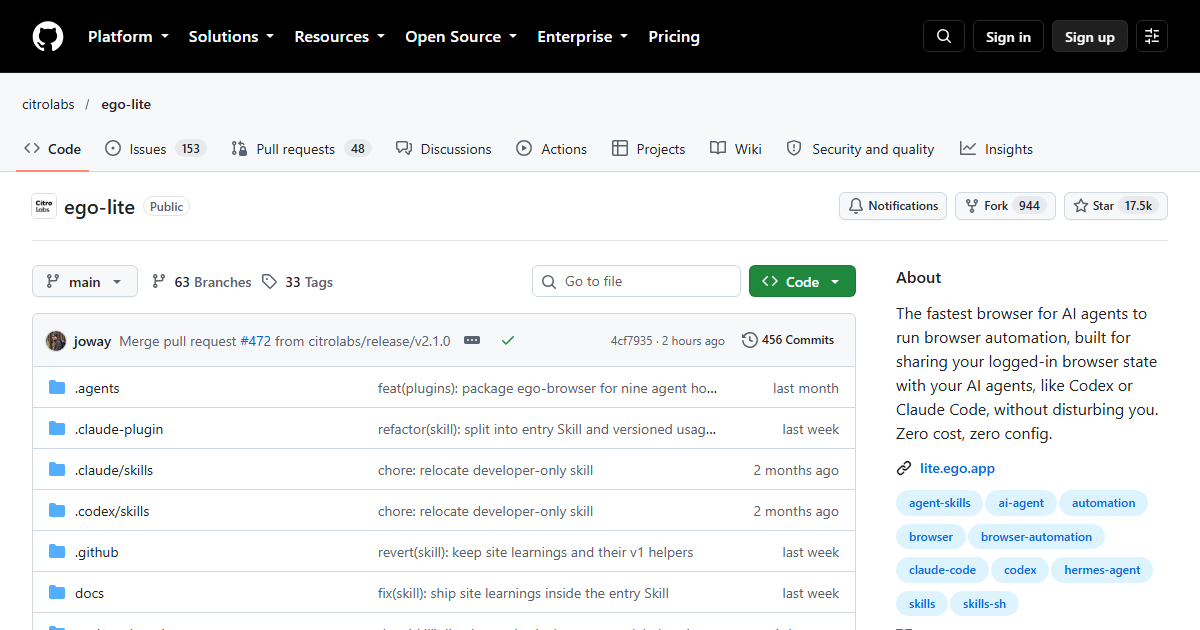
One-liner: ego-lite is an open-source browser environment for AI agents: the human and the agent each get an independent Space inside the same browser, so the agent can operate real, logged-in web sessions without stealing your tabs.
Verified facts (checked 2026-09-21)
| Attribute | Value | Source |
|---|---|---|
| GitHub stars | 16,309 (857 forks) | citrolabs/ego-lite via GitHub API, 2026-09-21 |
| License | MIT | GitHub API, 2026-09-21 |
| Last push | 2026-09-21 (same day) | GitHub API |
| Owner | citrolabs (not a repo named “ego-browser”) | repository metadata |
| Platform | macOS first; Windows version not released at check time | repository README and issue tracker |
| Agent integration | Skills connect directly to coding agents such as Codex and Claude Code; repository topics include hermes-agent |
README / GitHub topics |
What it actually does
The pitch is parallelism with isolation. You keep browsing normally in your own space; the agent works in a separate one, reusing the browser’s real login state instead of asking you to paste session cookies into a headless script. That solves the most annoying failure mode of agent-driven web automation — sites that require authenticated, human-shaped browser sessions.
The project ships agent skills, so a coding agent can open, navigate, and act inside the agent Space without a bespoke automation layer you have to write yourself. Hermes-related workloads are explicitly a supported integration point via its published topics.
What the marketing doesn’t say
Platform coverage is the honest limitation: Windows is not available yet, so if your fleet is Windows this is a macOS-only option as of 2026-10-16. It is also a young project whose feature surface — Space management, session scoping, security boundaries — is still moving; read the current README rather than assuming a six-month-old tutorial matches the current build.
Who should use it
Developers already running coding agents (Codex, Claude Code, Hermes-style setups) who keep hitting the “the agent can’t use the logged-in web” wall and want a local-first, MIT-licensed answer. If you need Windows or a fully managed cloud browser, look elsewhere for now.
Repository stats, license text and platform status verified against primary sources on 2026-09-21. This entry follows our verification policy: every claim here was checked against primary sources, not copied from other reviews.
Repository facts (GitHub API + raw README, checked 2026-10-16)
| Attribute | Value |
|---|---|
| Stars / forks | 17,466 / 944 |
| Open issues | 201 |
| Licence | MIT |
| Primary language | JavaScript |
| Repository created | 2026-04-16 |
| Last push | 2026-10-16 |
| Archived | No |
| Homepage | lite.ego.app |
| Topics | browser-automation, agent-skills, claude-code, codex, hermes-agent, skills, skills-sh |
Six months old, actively pushed, permissively licensed — and the topic list is the fastest way to understand the positioning: this ships as skills for named coding agents, not as a standalone browser product you learn separately.
The pitch and how the README is organised
Banner line: “The fastest browser for AI agents to run web automation”, with the description expanding it to “built for sharing your logged-in browser state with your AI agents, like Codex or Claude”. Sections, in order: Demo · Quick Start (1. Install, 2. Try your first task) · Highlights of ego lite · ego lite vs existing products · Benchmarks · Docs · Community · Star History · License.
Two sections are worth reading with a reviewer’s eye:
- “ego lite vs existing products” — a vendor comparison table. It will be accurate about the other products’ feature lists and favourable about the trade-offs it chose to show. Use it to discover which alternatives exist, then check the ones you shortlist directly.
- “Benchmarks” — the numbers are the project’s own. Latency claims for a browser controlled by an agent depend heavily on harness, network and page under test; reproduce them on a page you know before quoting them.
Distribution, as listed in the README
Download badges for Apple Silicon and Intel macOS (.dmg from cdn.ego.app), Discord,
X (@ego_agent), Docs at lite.ego.app/document, MIT licence, and a Star History
chart. The quick start is two steps — install, then run a first task — which is the right shape for
something designed to be discovered by an agent rather than read as a manual. The README is
published in English, Simplified Chinese, Japanese and Korean.
What to verify before handing it your browser
- Shared logged-in state is the whole feature and the whole risk. If the agent inherits your session, it inherits your bank tab, your email and your admin consoles unless the browser scope is partitioned. Read what “sharing your logged-in browser state” means precisely — which profile, which window, which permissions — in the docs, not the banner.
- Agent skills are code that runs. Installed skills for Claude Code, Codex or Hermes Agent are instructions your agent will execute; review what the skill files request before enabling them.
- macOS-only downloads at the time of this check: if your agents run on Linux or Windows hosts, confirm whether a build exists before planning around it.
Source note: repository statistics come from the GitHub API; section names, download badges, banner line and the four-language README list come from the raw README read on 2026-10-16. We did not install ego lite, so every performance claim above remains the project’s.