Price terms as published
Each line is the vendor’s own wording, split from the price capture checked on 2026-09-22. Nothing here is rounded, converted or re-worded — the full sentences stay in the review below. Lines that carry only a price continue the plan named on the line above, in the vendor’s own order.
| # | Plan / term | Checked |
|---|---|---|
| 1 | Free (open source, MIT with third-party component exceptions) | 2026-09-22 |
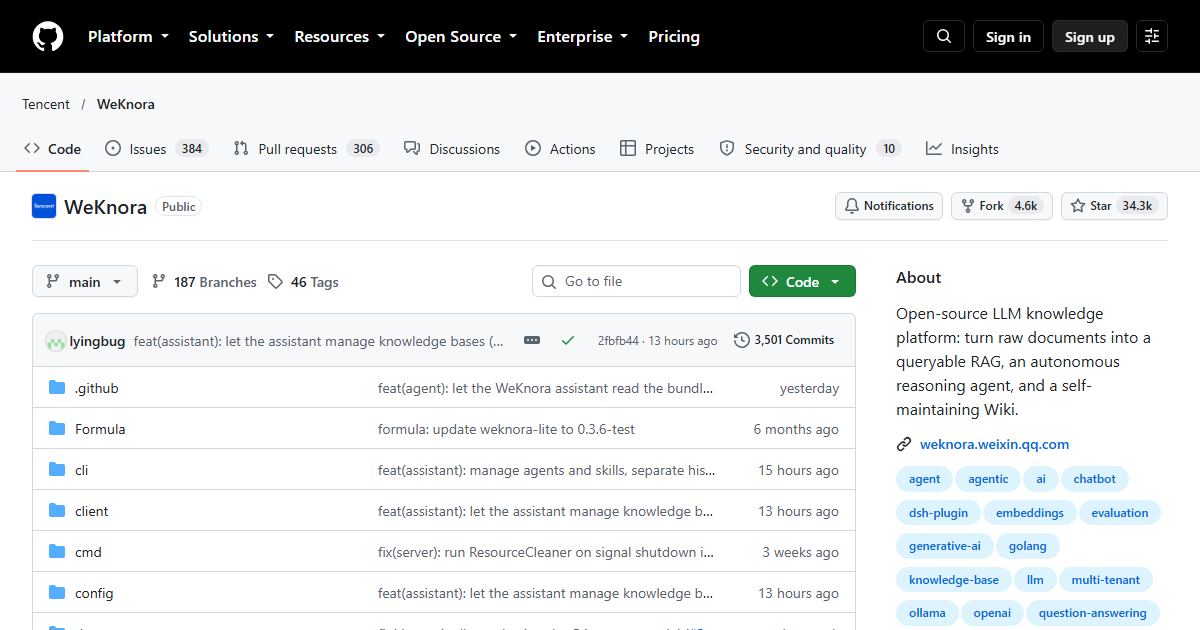
One-liner: WeKnora is an open-source knowledge platform that turns raw documents into a queryable RAG system, an agent that reasons over them, and a wiki that maintains itself as sources change.
Verified facts (GitHub API + LICENSE original, 2026-09-22 00:26–00:40 UTC+8)
| Attribute | Value | Source |
|---|---|---|
| GitHub stars | 28,424 (3,824 forks, 596 open issues+PRs) | Tencent/WeKnora via GitHub API, 2026-09-22 |
| License | MIT, except listed third-party components | LICENSE raw text: “licensed under the MIT License except for the third-party components listed below… Tencent does not impose any additional limitations beyond… the respective licenses of these third-party components” + THIRD_PARTY_NOTICES.md and licenses/ dir |
| API license flag | NOASSERTION — known false read, human-verified from LICENSE | GitHub API vs. file text |
| Language | Go | GitHub API |
| Created | 2025-07-22 | GitHub API |
| Last push | 2026-09-21 — same-day activity | GitHub API |
| Positioning (repo description) | “turn raw documents into a queryable RAG, an autonomous reasoning agent, and a self-maintaining Wiki” | GitHub API |
What the license carve-out actually means
The MIT grant covers WeKnora’s own code. Bundled third-party components keep
their own licenses (the LICENSE points to THIRD_PARTY_NOTICES.md and a
licenses/ directory), and users are responsible for complying with those too.
For self-hosted commercial internal use this is usually a non-issue; for
redistributing a derived product, read the notices file first.
The catches
- Self-hosted stack weight. RAG + agent + wiki platform in Go implies vector-store and model-endpoint dependencies you operate yourself.
- 596 open issues+PRs — big surface, actively triaged (last push same day), but expect integration edges.
- Chinese-first docs ecosystem (Tencent OSS convention); English README exists but community knowledge skews zh.
Who should use it
Teams that want a documented, MIT-licensed alternative to closed knowledge assistants — internal wikis with agent retrieval, compliance-sensitive RAG, or simply owning the stack instead of renting it.
Stars/forks/dates from GitHub API 2026-09-22; license wording quoted from the raw LICENSE file fetched 2026-09-22. No deployment performed for this page; no hands-on claims are made.
Repository facts (GitHub API + raw README, checked 2026-10-16)
| Attribute | Value |
|---|---|
| Stars / forks | 34,277 / 4,571 |
| Open issues | 692 |
| Licence (GitHub API) | NOASSERTION — see the note below |
| Primary language | Go |
| Repository created | 2025-07-22 |
| Last push | 2026-10-15 |
| Archived | No |
| Homepage | weknora.weixin.qq.com |
| Topics | rag, semantic-search, vector-search, reranking, knowledge-base, wiki, ollama, openai, multi-tenant, evaluation, agent |
Licence note: GitHub’s API does not classify the LICENSE file (NOASSERTION), while the
README badge explicitly displays MIT. That is usually a formatting issue in the licence file
rather than a real difference — but if you are legal-reviewing adoption, read the file itself
instead of trusting either the badge or the API.
What the project actually is
The repository description is precise: “Open-source LLM knowledge platform: turn raw documents
into a queryable RAG, an autonomous reasoning agent, and a self-maintaining Wiki.” Three
deliverables from one platform, and the topic list backs that up — retrieval, reranking and vector
search next to wiki and agent, with multi-tenant and evaluation as the two topics that
hint at where the project is aimed (teams and measurable retrieval, not a single-user demo).
Release cadence, from the README’s own changelog
| Release | Date in README |
|---|---|
| v0.8.3 | 2026-10-14 |
| v0.8.2 | 2026-09-24 |
| v0.8.0 | listed with release notes link |
A minor release roughly every three weeks, with the previous one two days before this check and
the last push the day before — this is an actively maintained repository, and the upgrade
instructions in the README (WEKNORA_VERSION in .env) mean you can pin a release instead of
tracking latest.
Distribution surfaces listed in the README
Docker Compose as the primary quick start (with explicitly marked optional services and a
separate upgrade section), other deployment methods, a Chrome extension, a WeChat Dialog Open
Platform badge, hosted docs at weknora.weixin.qq.com/docs, and a release badge for v0.8.3.
What to check before deploying
- 692 open issues is a large number in absolute terms for a project with 34k stars — read the labels before assuming it signals instability; large-community projects accumulate enhancement requests at the same rate as they fix bugs.
- The wiki that maintains itself and an autonomous reasoning agent are the two claims that need your data, not ours: they imply model calls and storage, so check which providers are supported in your region and where documents land at rest.
- Go service + optional services + multi-tenant means this deploys as a stack, not a binary. Budget for the vector store and model access before you evaluate quality.
Source note: repository statistics come from the GitHub API and the release table, licence badge, quick-start headings and project description from the raw README, all read on 2026-10-16. We did not deploy WeKnora for this entry.