Price terms as published
Each line is the vendor’s own wording, split from the price capture checked on 2026-09-22. Nothing here is rounded, converted or re-worded — the full sentences stay in the review below. Lines that carry only a price continue the plan named on the line above, in the vendor’s own order.
| # | Plan / term | Checked |
|---|---|---|
| 1 | Free (mixed/custom license — see terms) | 2026-09-22 |
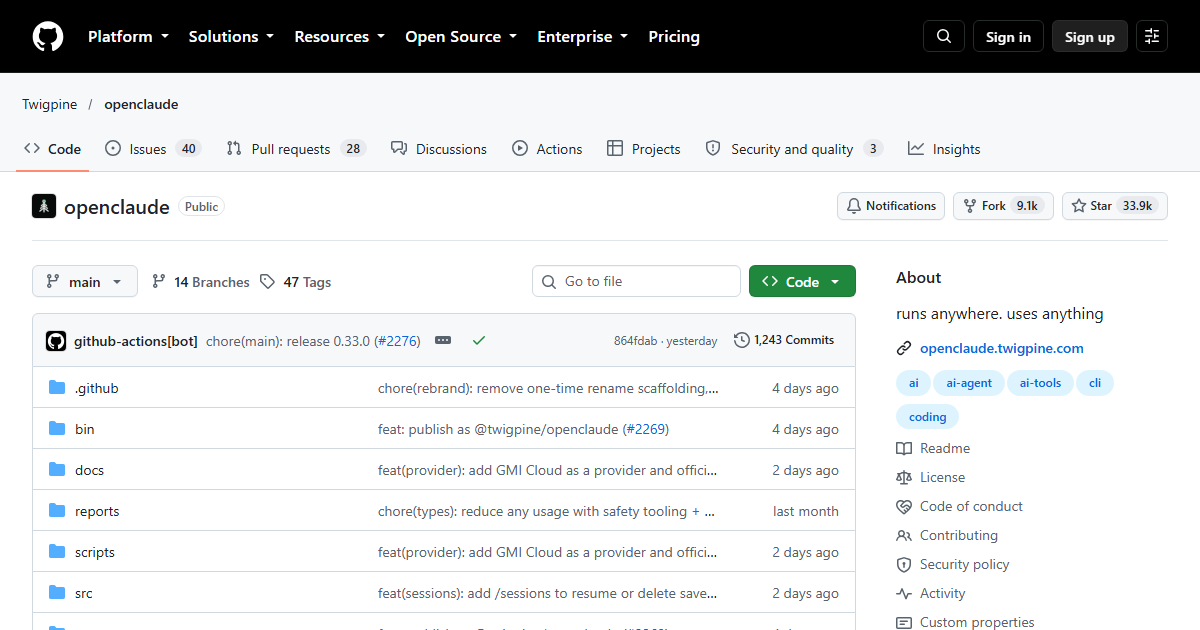
One-liner: OpenClaude is a community project built from code derived from Anthropic’s Claude Code CLI, with the goal of making it “run anywhere, use anything.”
Verified facts (checked 2026-09-22)
| Attribute | Value | Source |
|---|---|---|
| GitHub stars | 33,469 (9,099 forks) | Gitlawb/openclaude via GitHub API, 2026-09-22 |
| License (GitHub classification) | NOASSERTION / Other — not an OSI-approved standard identifier | GitHub API, 2026-09-22 |
| Repository created | 2026-04-01 | GitHub API |
| Last push | 2026-09-21 | GitHub API |
| Open issues | 69 | GitHub API |
What it actually does
Functionally, the project takes the Claude Code agent experience and reworks it for broader portability — the repository description is “runs anywhere. uses anything.” That appeal explains its traction: a large community clearly wants Claude Code-style agent workflows without the original client’s platform or provider constraints.
The license issue, stated exactly
This is not a clean MIT project, even though coverage often labels it that way. The repository’s own LICENSE/NOTICE file says, in substance:
- The repository contains code derived from Anthropic’s Claude Code CLI, whose original source is proprietary and subject to Anthropic’s Commercial Terms of Service;
- Modifications and additions by OpenClaude contributors are offered under the MIT License “where legally permissible”;
- The underlying derived code remains subject to Anthropic’s copyright;
- The project does not have Anthropic’s authorization to distribute the proprietary source, and users and contributors “should evaluate their own legal position.”
In other words: the MIT text covers only the contributor modifications, and only to the extent law allows. Calling the whole project “MIT licensed” would misstate its terms.
Who should use it
Individuals experimenting locally with an alternative Claude Code build, who understand they are taking on the legal risk themselves. For anything commercial — embedding it in a product, redistributing it, or building a service on it — get legal advice first, because the project’s own notice flags an unresolved copyright question. If license clarity is a hard requirement for your stack, prefer agent harnesses shipped under a standard MIT or Apache-2.0 license from their original authors.
Repository stats and the repository’s own LICENSE/NOTICE text verified against primary sources on 2026-09-22. This entry follows our verification policy: every claim here was checked against primary sources, not copied from other reviews.
Repository facts (GitHub API + raw README, checked 2026-10-16)
| Attribute | Value |
|---|---|
| Stars / forks | 33,927 / 9,140 |
| Open issues | 69 |
| Licence (GitHub API) | NOASSERTION — see the note below |
| Primary language | TypeScript |
| Repository created | 2026-04-01 |
| Last push | 2026-10-15 |
| Archived | No |
| Linked homepage | openclaude.twigpine.com |
| Topics | ai, ai-agent, ai-tools, cli, coding |
Licence note: the repository’s own short description reads “runs anywhere. uses anything”, and
the thing buyers of a Claude Code port care about most — which licence the open port ships under —
is exactly what GitHub’s API cannot classify here (NOASSERTION). The README links a licence file
and carries Trendshift badges for repository 25807 (daily, monthly, repository), but if the
licence matters to your legal review, read the file itself rather than a badge or a summary.
What the README documents
The positioning sentence is: “OpenClaude is an open-source coding-agent CLI for cloud and local model providers”, keeping one terminal-first workflow: prompts, tools, agents, MCP, slash commands, and streaming output across backends. The provider list named in the README is concrete: OpenAI-compatible APIs, Gemini, GitHub Models, Codex OAuth, Codex, Ollama and Atomic Chat.
The workflow sections, in order
Install · Start · Resume or fork a conversation · Manage saved conversations · Background sessions · OpenClaude config cutover · Fastest OpenAI setup · Fastest local Ollama setup · Setup Guides · Supported Providers · What Works · Provider Notes (plus a Partners block near the top).
Three of those are the reason to read this README rather than a feature list:
- Resume or fork — conversation state is a first-class object you can branch, which is what makes side-by-side comparison of two providers on the same task possible.
- Background sessions — long agent runs that survive the terminal you started them in.
- Config cutover — a documented path for moving an existing Claude Code configuration across, which tells you the maintainers expect migration traffic, not first-time users only.
What to verify before switching
- Provider parity, not provider count. The README separates Supported Providers from What Works and Provider Notes — read those two sections for the gaps, because “OpenAI-compatible” covers a wide range of tool-calling quality.
- Licence and provenance. An open port of a proprietary CLI lives or dies on its licence terms and on how it tracks upstream changes; the repository is four months old with 69 open issues, so pin a version and follow the changelog before you make it your daily driver.
- Credential surface. OAuth flows for Codex plus local Ollama endpoints mean tokens for several vendors on one machine; decide up front where they are stored.
Source note: repository statistics come from the GitHub API; positioning text, provider list and section names come from the raw README, both read 2026-10-16. Nothing was installed or run for this entry.