Price terms as published
Each line is the vendor’s own wording, split from the price capture checked on 2026-09-22. Nothing here is rounded, converted or re-worded — the full sentences stay in the review below. Lines that carry only a price continue the plan named on the line above, in the vendor’s own order.
| # | Plan / term | Checked |
|---|---|---|
| 1 | Free (MIT) | 2026-09-22 |
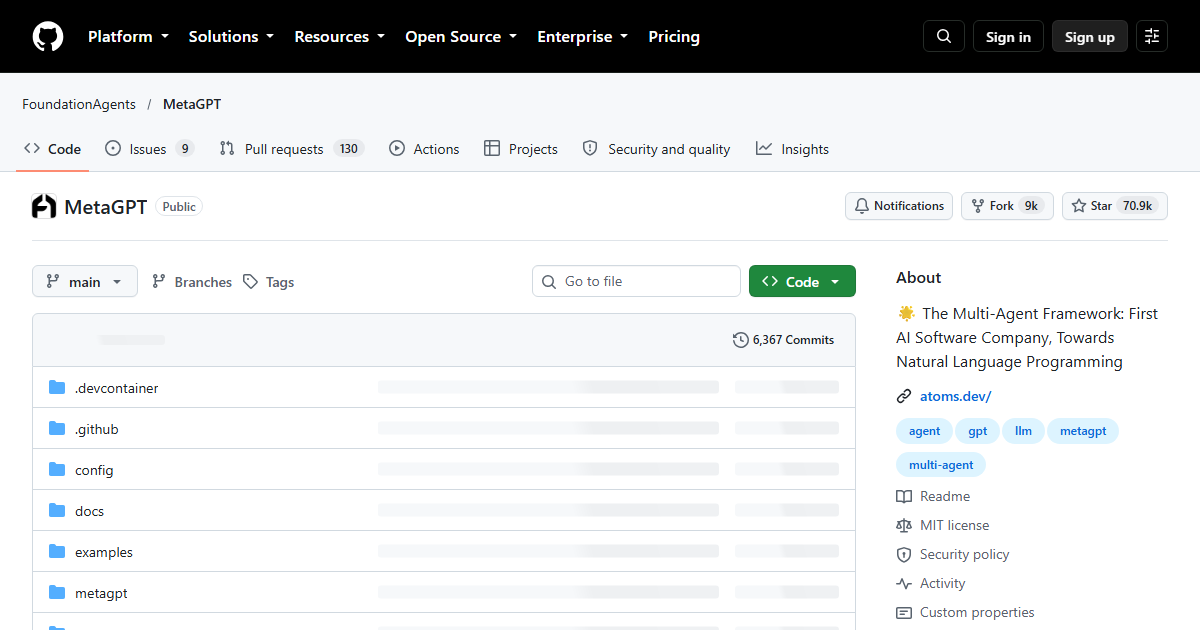
One-liner: MetaGPT is the multi-agent framework that popularized the “AI software company” metaphor: agents take defined roles — product manager, architect, engineer — and collaborate toward natural-language programming.
Verified facts (checked 2026-09-22)
| Attribute | Value | Source |
|---|---|---|
| GitHub stars | 70,539 (8,962 forks) | FoundationAgents/MetaGPT via GitHub API, 2026-09-22 |
| License | MIT | GitHub API, 2026-09-22 |
| Repository created | 2023-06-30 | GitHub API |
| Last push | 2026-01-21 — no pushes for roughly 8 months at check time | GitHub API |
| Open issues | 135 | GitHub API |
| Owner | FoundationAgents | repository metadata |
What it actually does
MetaGPT assigns structured SOPs (standard operating procedures) to multiple agents, encoding human software-team workflows into role-based collaboration. A single line of requirements can flow through planning, design and implementation steps across specialized agents. It was one of the projects that defined the multi-agent-framework category in 2023–2025 and remains a common citation and teaching reference for role-based agent architectures.
What the marketing doesn’t say
The honest caveat is maintenance status. The canonical repository’s last push was 2026-01-21: roughly eight months of silence at check time, with 135 open issues. The MIT license is clean and the code still runs, but a framework whose main repository is stalled will gradually drift away from current model APIs, dependency versions and security patches. Anyone adopting it should assume they are maintaining their own fork going forward, or investigate whether an active community fork has taken over.
Who should use it
Learners and researchers studying role-based multi-agent architectures, and teams willing to fork and maintain the codebase themselves. If you are choosing a foundation for a new commercial product and expect upstream fixes, compatibility updates and active issue triage, look at actively maintained frameworks instead — the star count reflects historical importance, not current velocity.
Repository stats, license and last-push date verified against primary sources on 2026-09-22. This entry follows our verification policy: every claim here was checked against primary sources, not copied from other reviews.
Repository facts (GitHub API + raw README, checked 2026-10-16)
| Attribute | Value |
|---|---|
| Stars / forks | 70,875 / 9,011 |
| Open issues | 139 |
| Licence | MIT |
| Primary language | Python |
| Repository created | 2023-06-30 |
| Last push to the repository | 2026-01-21 |
| Archived | No |
| Linked homepage | atoms.dev |
Almost three years of history and 70k stars — and no code push since January 2026, which is now nine months of silence. GitHub still reports the repository as not archived, so nothing here says “deprecated”; it says “unattended”. Treat the star count as evidence of past influence, not of present maintenance.
What the README still advertises
The README’s News section is itself a freshness indicator: its newest entries are dated March 2025
— mgx.dev being named Product of the Week on Product Hunt (2025-03-10), the MGX launch
(2025-02-19), and the AFlow paper accepted at ICLR 2025 as an oral, described there as top 1.8%
and #2 in the LLM-based agent category. In other words, the project’s own announcements stopped
before the code did, roughly eighteen months before this check.
Architecturally the pitch is unchanged from what made the project famous: one line of requirement
in, and out come user stories, competitive analysis, requirements, data structures, APIs and
documents, with internal roles for product manager, architect, project manager and engineer. The
stated philosophy is Code = SOP(Team) — standardised procedures applied to a team of LLMs.
Install requirements as documented
The README asks for Python 3.9 or newer but less than 3.12, and offers
pip install --upgrade metagpt (or a git URL install) as the install path. Configuration is
deferred to docs.deepwisdom.ai. The Python upper bound is the practical catch: an environment
already on 3.12 or 3.13 needs a separate interpreter for this package, which is a fair amount of
setup work for a framework whose last commit predates the current year’s agent tooling.
Reading these two tables together: popularity is high, activity is not. If you adopt anything from MetaGPT today, pin the commit you tested, read the open issues for known breakage against your model provider, and treat the framework as a reference implementation of the role-and-SOP pattern rather than as a maintained dependency.