Price terms as published
Each line is the vendor’s own wording, split from the price capture checked on 2026-09-21. Nothing here is rounded, converted or re-worded — the full sentences stay in the review below. Lines that carry only a price continue the plan named on the line above, in the vendor’s own order.
| # | Plan / term | Checked |
|---|---|---|
| 1 | Free (Apache-2.0 code) | 2026-09-21 |
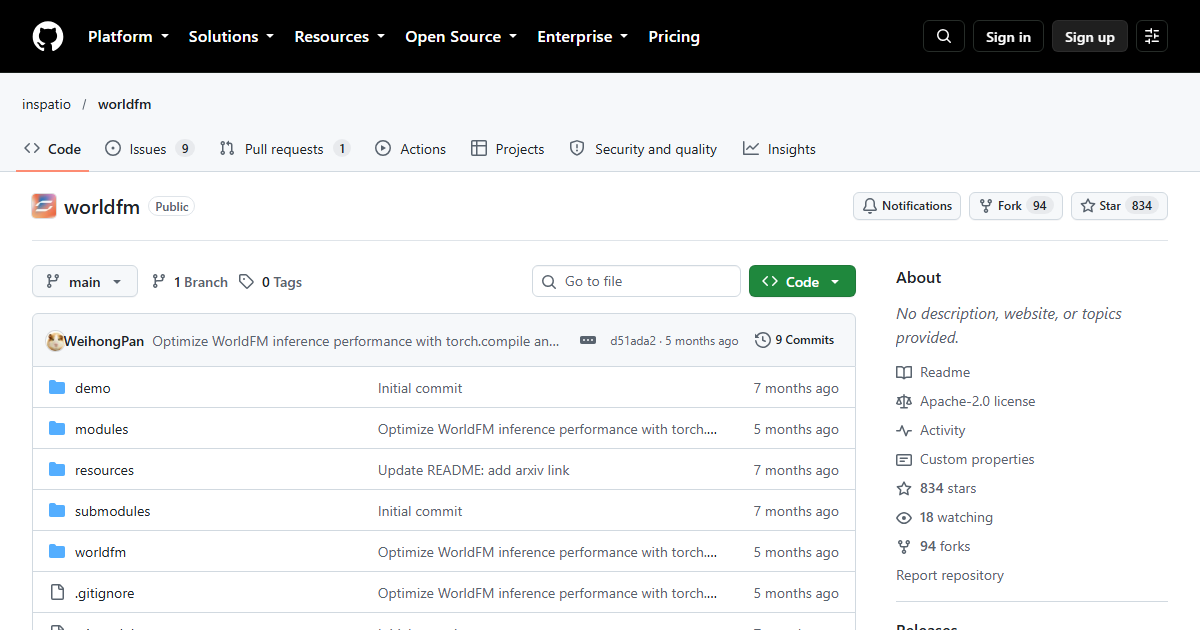
One-liner: InSpatio-WorldFM is an open-source research project from InSpatio aiming at real-time, multi-view consistent spatial reasoning and 3D world generation on consumer hardware such as a single RTX 4090.
Verified facts (checked 2026-09-21)
| Attribute | Value | Source |
|---|---|---|
| GitHub stars | 833 (94 forks) | inspatio/worldfm via GitHub API, 2026-09-21 |
| License | Apache-2.0 | GitHub API, 2026-09-21 |
| Created | 2026-03-03 | GitHub API |
| Last push | 2026-05-06 | GitHub API |
| Tech report | arXiv 2603.11911 | project page |
| Code lineage | Built on PixArt-Sigma and HunyuanWorld components | repository README |
| Target hardware | Consumer GPU (RTX 4090 class) | README claims |
What the project claims
World models predict how a 3D scene evolves as an agent moves through it. InSpatio’s pitch is doing this in real time with multi-view consistency on hardware normal researchers own, rather than requiring a datacenter. The same organization also publishes InSpatio-World, a related 4D world-model project (arXiv 2604.07209), which suggests a series rather than a one-off demo.
Why this is an observe-list entry
Two honest caveats, both taken from the repository itself:
- The core generation model is not open. The released code is an Apache-2.0 scaffold that plugs in components like HunyuanWorld; you cannot reproduce the headline result from the paper using only what is in the repo.
- It is young and quiet. Created 2026-03-03 with a sub-kilostar community, and the last push predates our check by months. Research teams often go quiet between releases; still, “promising paper” and “shipped tool” are different things, and this one is closer to the former.
We deliberately do not restate benchmark numbers from the paper, since we could not verify them against runnable artifacts.
Who should watch it
Researchers and builders tracking the world-model space for robotics, gaming, or spatial AI, who want to follow an Apache-licensed codebase as it matures. If you need a usable 3D generation tool this quarter, install something with a released model instead.
Repository stats, license and release status verified against the GitHub API on 2026-09-21. This entry follows our verification policy: every claim here was checked against primary sources, not copied from other reviews.
Repository facts (GitHub API + raw README, checked 2026-10-16)
| Attribute | Value |
|---|---|
| Stars / forks | 834 / 94 |
| Open issues | 10 |
| Licence | Apache-2.0 |
| Primary language | Python |
| Repository created | 2026-03-03 |
| Last push | 2026-05-06 |
| Archived | No |
| Homepage / topics | neither set in the repository metadata |
A small project by star count, and — unlike most entries in this category — quiet: no push in roughly five months and only ten open issues. Quiet is not the same as broken; for a research repository it usually means the paper’s code froze when the experiments ended.
What the README says the system does
WorldFM, a real-time multi-view diffusion model. Given a reference image and target camera poses, WorldFM generates images at those new viewpoints.
Three things follow from that sentence: it is real-time (a latency claim, not a quality claim), it is multi-view (the output must stay geometrically consistent across views), and it takes camera poses as input, which means you control the virtual camera rather than prompting for a new picture. The README links a paper (arXiv), a Discord, and a project site with videos and interactive results — the standard research-repository shape.
The setup burden, exactly as documented
Installation is a conda environment (setup.sh, or a manual WorldFM.yaml) pinned to Python
3.10, PyTorch 2.5, CUDA 12.4, after which it installs pip dependencies and initialises four git
submodules — HunyuanWorld-1.0, MoGe, Real-ESRGAN, ZIM — building Real-ESRGAN and ZIM in
development mode. The manual path additionally pins a specific MoGe commit hash, which tells you
the combination is sensitive to dependency drift.
The single most important sentence in the README
For consistent scene generation, we employ an internal generative model that is not included in the open-source release. To support reproducibility, users can integrate alternative open-source panorama generation models (e.g., HunyuanWorld-1.0).
Read plainly: the open-source release is incomplete on purpose. The paper’s exact pipeline cannot be reproduced from this repository; you substitute an open panorama model, which the maintainers say “does not impact the core spatial reasoning framework”. That substitution is a reasonable research compromise, and it also means any output you produce from this repo is not necessarily the output in the paper — worth stating before you compare results.
Practical reading
- GPU first. CUDA 12.4 plus four submodules means a Linux box with a recent NVIDIA driver and disk to spare; there is no hosted endpoint listed in the README.
- Output is a video or frames. Usage shows MP4 by default with an option to save per-frame PNGs, so evaluation is visual by nature — bring your own test images and camera paths.
- 10 open issues / 834 stars suggests a small, undisturbed user base; if you depend on it, budget for maintaining the fork yourself, given the last push was in May.
Source note: repository statistics come from the GitHub API; the quoted sentences, submodule list, environment pins and output options come from the raw README read on 2026-10-16. Nothing was installed or run for this entry.